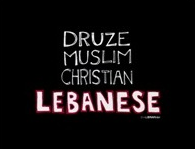
Elimination of Sectarianism: If Not Now, When?

lebanese_unityBy Ghassan Karam, Special to Ya Libnan

The current Lebanese political structure is built on two irrational and undemocratic principles: (1) Rigid political sectarianism for allocating posts and (2) equal distribution of parliamentary seats along a Christian- Moslem axis. In a country where political identity does not arise from citizenship but from cosmopolitan, regional, racial or religious identification the above is a recipe for disaster. If tends to perpetuate the divisiveness instead of the healing and it will emphasize the attributes that divide us rather than those that we hold in common.  And the most egregious part of the above formula is that it treats some as being more equal than others by allocating to the Christians a proportionally higher level of representation than the raw numbers establish.  It is as if each 4 Christian votes count for five, a 25 % premium.

Since it would be very difficult to rationalize such an inequitable and unjust system one finds that the Lebanese have repeatedly lent their vocal support to the need to abolish sectarianism provided no one ever does.  This is precisely the reason for the maelstrom that has engulfed the Beri- Suleiman recent proposal to establish a committee that will recommend steps to be adopted in an effort to abolish “political sectarianism”.

Politicians on both sides of the aisle, especially those that belong to the March14 political grouping, have always advocated the enactment of the Taif accords which recommends a bi cameral Lebanese Parliament in addition to abolishing sectarianism in elections and civil service appointments .  Meritocracy is to become the only workable criteria both in elections and in appointments. It would not be far fetched to envisage such a meritocracy as being essentially secular.  Recent events have been very revealing and quite informative.  We now know that the support for a non sectarian system, especially that of the Maronites, was forthcoming but only with some strenuous  preconditions. Patriarch Sfeir, the Kataeb, the Lebanese Force, The Free Patriotic Movement among others have already stated very clearly their opposition to the plan by speaker Beri to form a committee as demanded by the Taif in order to abolish political sectarianism on the grounds that it is not the proper time for such a proposal.

So how can they be for it and yet against it at the same time?  All the parties mentioned above in addition to some independents such as Justice Minister Najjar and Labour Minister Harb claim that they are in principle for eliminating confessionalism but are opposed to the step at the moment because it might result in the underrepresentation of the Christians. Yes you heard it right. They are for eliminating confessionalism provided it does not diminish their privileged position. This logic demands a clear cut answer to two issues: (1) if the status quo is to be maintained then why bother and change the system in the first place?  And (2) isn’t the whole idea behind electing representatives on merit based on the principle that ones religious affiliation is not a factor in their identity?

Sectarian politics is the anathema to democracy, efficiency justice and equity.  One cannot support it provided it results in favourable outcomes to her group.  The benefits are to accrue to the common good and the results are known only after the fact, after the elections are held.  If we are to elect representatives based on their allegiance to the state and their commitment to its constitution then it shouldn’t matter whether we elect only females, only Shiites or only short men. What matters is that the representatives are Lebanese.

The accusations against Speaker Beri for daring to suggest that it is time to tackle this thorny issue of eliminating “political sectarianism”  ought to be dismissed as disingenuous protestations. The timing of the announcement by Mr. Beri might very well be intended to stifle the attempts of some to make an issue of the legitimacy of the arms of Hezbollah but that is not material. A serious and thorough national dialogue about how to de-sectarianize the political system in Lebanon is already 66 years overdue and must not be postponed again. Our future depends on it.

A Podcast of the above can be heard on: ramblings11.mypodcast.com

Comments: wp.karam@gmail.com

Discussion

6 comments for “Elimination of Sectarianism: If Not Now, When?”

  1. I think lots of Lebanese people do not have the political maturity to elect the most eligible candidate becuse they will thik first what religion does belong to is he going to make decisions whats best for the country or his religious affiliation, thats where the danger is to elect somebody inept because he belongs to a certain religion.The problem could be solved starting in kindergarden love of country first,God never said this religion is better then the other, so start thinking with your head not the heart.

    Posted by Raffi Daghlian | November 28, 2009, 8:59 pm
  2. Sectarianism is present in all parts of the world. I do not agree that the main focus should be to abolish sectarianism in Lebanon because it is simply impossible, not now, not ever!. Lebanon’s religious divisions are extremely complicated and religion will always be an important criterion to take into consideration: you forgot to mention that even our laws, our codes are based on religion.
    Since the Lebanese system is a duplicate of other systems I allow myself to compare with other systems.
    I take India as an example: why is it that such a country is the most populous democracy in the world? It has many religions? Many diverse and contradictory groups and yet political parties are not based on individuals. I believe that the main political problem in Lebanon lies on “followship” (taba3iya).
    This is not knew, we all know that . It is family sectarianism: Jumblat, Gmeiyl, Mouawad..oh and it has become hereditary transferred! People follow Aoun, Berri, Hariri..but Never an idea. Yesterday Aoun was against Syria, against Al Taef, his followers were against Syria and against Al Taef, today Aoun is pro-syrian and indeed his followers have become pro-syrian. This is one example out of hundred..
    I agree with a previous comment posted on the Article: it is all about Education. However, education should be focused on political ideology, on a cause each Lebanese should believe in and please, please let’s not forget the past and History that we do not agree on: let’s not forget these Muppets and their changing politics every now one then! We really have to believe in a political ideology and not in them!

    Posted by Micheline Barbar | November 30, 2009, 3:23 pm
  3. G. Karam responds.

    Raffi,
    I am in total agreement with you regarding the role of education. An educated and well informed citizenry is essential for the proper functioning of a vibrant democracy.

    Micheline,
    In a very narrow and technical sense you are correct when you say that sectarianism is found all over the world and that it cannot be eliminated.
    The proper word should have been confessionalism but I opted for sectarianism because that appeared to be the term of choice by the English language press in Lebanon.
    We all know , or should know , that when one speaks about the implementation of the Taef accords that the topic is the elimination of the system that allocates elected posts and civil service positions according to a formula based on religious affiliation. That, by the way, was made crystal clear from the first sentence in the article. Actually the elimination of sectarianism/confessionalism is nothing else but a first step in the creation of a secular society. You are right, one cannot legislate how people think but society is under an obligation, a moral one I might add, to treat all its members equally irrespective of their religious beliefs.
    And yes I agree that “political feudalism” and democracy are not compatible.

    Posted by Ghassan Karam | December 1, 2009, 6:08 pm
  4. Education will teach this generation, and this generation will teach the following generation. Whatever it is, Lebanon can no longer have a divided society, whether this is the case or not, and be labelled as a ‘confessional’ state. Those ‘muppets’ are now gone and we need to build a new start, and I strongly believe that eventually, when the politicans play a good example in the government, the population will realise that sectarianism is wrong. However at the end of the day Muslims, Christians and Druze must all be treated equally, in soceity and politics.

    Posted by Louay Faour | December 2, 2009, 12:17 pm
  5. I believe that in an ideal world, the best person desrves the seat, regardless of their religeon. However, this does not work in Lebanon, this secterian system keeps all sects happy, appeases their desire for influence, and safeguards their intrests. There is now peace and stability in Lebanon, and by the grace of God it will remain like this. If every sect is happy with the current constitution, and it retains peace, then why change it?

    Posted by lawrence | December 2, 2009, 10:17 pm
  6. Louay,
    You are absolutely correct. Equality of opportunity cannot be granted under a sectarian/confessional system.

    Lawrence,
    How do you measure whether a sect is happy? Is that done by asking those that are at the top of the pyramid and are thus the major beneficiaries of the current arrangement ? A responsible state is usually driven to satisfy the “common good” and not what is good for an individual tribe since what is good for one is not necessarily good for the whole.

    Posted by Ghassan Karam | December 3, 2009, 5:24 am

Post a comment

Please respect the community. Comments that contain personal attacks or inappropriate language will be removed.

Advertise With Us


Follow Ya Libnan on Twitter @ya_libnan
Looplit - Designer Accessories
Ya Libnan Café Ya Libnan Online Shop