By Zeina Karam
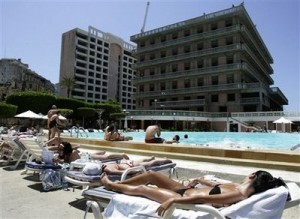
BEIRUT – Blocks of historic Ottoman-era buildings, once pocked by bullet holes, have been majestically restored, and new high-rise apartment towers with mirrored facades front the glittering Mediterranean, signs of an unprecedented real estate boom that is transforming Lebanon’s capital.
Beirut’s building craze, despite chronic political turmoil in recent years, has astonished even the experts, turning Lebanon into an investment haven at a time when other regions — including the oil-rich Persian Gulf — are hemorrhaging cash. Even the seemingly unstoppable city-state of Dubai has hit the brakes after a massive debt crunch there rattled world financial markets.
“The market is continuing to really stun a lot of people and to attract some new players,” said Raja Makarem, founder of Ramco, a leading real estate company. He added that Lebanon has seen a 30 percent increase in property value for each of the past four years.
Lebanon has seen a window of relative peace since the devastating Israel-Hezbollah war in 2006 and deadly gunbattles two years later between Hezbollah and its political rivals in the streets of Beirut. Since then, political wrangling has continued, but Lebanon’s many factions have managed to keep their differences from exploding into violence.
Moreover, the financial meltdown that hit Dubai and elsewhere may have even helped Lebanon. While real estate buyers in Dubai were mostly investors and speculators depending on bank loans, the demand in Beirut is mainly from end users buying with cash, Makarem and other experts said.
Real estate isn’t the only sector booming: Tourists have rediscovered the coastal nation with its beaches, scenic mountains and freewheeling lifestyle. This week officials announced that Lebanon attracted a record 1.8 million foreign visitors in 2009, earning an estimated $7 billion, beating the previous record of 1.4 million tourists in 1974 — just before the 1975-1990 civil war broke out.
For many, especially those who have not visited Beirut in a while, the transformation from the real estate frenzy is striking.
Blocks of elegant buildings with apartments selling at prices ranging between $5,000 and $8,000 per square meter have arisen downtown. Some are restorations of buildings dating back to the era of 19th Century Ottoman rule, others are brand new ones on plots where old rubble had long been bulldozed away. High-rises also now stand on land reclaimed from the sea.
The names of the new projects are as ostentatious as the developments themselves: The Beirut Souks, Venus Towers and Sama Beirut (Beirut Sky) are just some of the massive architectural projects under way.
“It’s the new Beirut. It looks nice and modern, but the problem is you have to be rich to enjoy it,” said Iman Haidar, a 42-year-old mother of two walking recently through Beirut Souks downtown — a 100,000 square meter (1,076,400 square foot) outdoor shopping mall.
The $300 million mall was built by Solidere, Lebanon’s largest construction and development firm, on the site of a historic souk, or market. But with its high-end retail outlets, it is nothing like the bustling souks that existed there before the civil war, where people from all over the country came to buy everything from vegetables and clothes to jewelry.
Solidere has taken the lead in flattening and then rebuilding much of downtown. Many, like Haidar, worry that Beirut is turning into a hotspot for high-end investments unaffordable to most Lebanese.
Experts say many of the new apartment owners are citizens of oil-rich Gulf nations and wealthy members of the 12-million strong Lebanese diaspora living abroad, who want to keep a pied-a-terre for regular visits to Beirut.
In fact, many of the luxury apartments lining Beirut’s famed corniche with panoramic views of the Mediterranean seem uninhabited, their glass facades unlit at night.
The number and value of property sales have leaped over the past year, according to figures released by Lebanon’s leading Bank Audi this week. The value of real estate sales in December around the country was $1.25 billion, up 40.8 percent from the same month in 2008. The number of sales in all of 2009 were up 27 percent over the previous year, it said.
“The global crisis that has strongly impacted the real estate market in the Gulf has somehow pushed investors to turn toward Lebanon,” said Tina Chamoun, marketing manager for Plus Properties, the Dubai-based real estate marketing company currently promoting two high-profile projects in Beirut.
The $700 million developments, Plus Towers and Venus Towers, involve five luxury residential towers with duplexes and penthouses downtown and along Beirut’s waterfront.
Chamoun says sales are going beyond expectations — mainly Lebanese, but also Gulf nationals.
Also, several five-star international chain hotels have opened in Lebanon before the end of the year, including waterfront Rotana and Four Seasons hotels and Le Gray, part of the British-owned CampbellGray Hotels.
Another of the new projects is the 50-story Sama Beirut, which promises to be Lebanon’s tallest skyscraper once completed in 2014.
The project, launched earlier this year, has been criticized by some who say the tower will destroy the architectural heritage in the historic area.
The developers were unfazed.
“Mixing modernity with history is enriching,” said Massaad Fares, who heads Prime Consult, marketing and financial consultants for Sama Beirut.
Mona El Hallak calls this diversity an urban catastrophe.
“Downtown Beirut used to be a meeting point for people from all backgrounds. Now if you don’t have money, there is nothing for you there, you feel you are not welcome,” said the architect, who is a member of the executive committee of APSAD, an organization that campaigns to classify Lebanon’s old buildings as heritage sites to protect them.
She says old cultural heritage buildings are being destroyed to make way for towers without any urban planning involved.
“Ten years from now,” she said, “the city will not even bear resemblance to the Beirut we know,” she said.

Leave a Reply
You must be logged in to post a comment.