By Nicholas Blanford
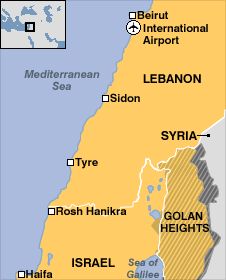
A renewed flurry of threats and warnings between Israeli officials and the leaders of Lebanon’s militant Shiite organization Hezbollah have sparked a serious bout of war jitters on both sides of the border which are also threatening to draw in other regional players. Israeli Foreign Minister Avigdor Lieberman publicly warned Syrian President Bashar al-Assad today that getting involved in a Lebanon-Israel conflict would result in the disintegration of his regime.
Though Israeli Prime Minister Benjamin Netanyahu then sought to smooth Syria’s feathers, reiterating his country’s desire for restarting peace talks, tensions are running high over a possible conflict with its neighbors. Israeli leaders grumble about Hezbollah’s military build-up since their month-long war in July 2006 and warn of a massive blow against Lebanon in the event of another clash. Hezbollah’s leadership remains defiant, saying they’re ready for another confrontation and confident of victory against the Jewish state.
The saber-rattling from both sides is part of the relentless psychological war between the two bitter foes, and shows that tensions continue to exist despite the fact that the border between them has experienced its longest period of calm in more than four decades. The United Nations peacekeeping force in south Lebanon, known as UNIFIL, says there is no indication that another war is imminent.
“The most important part is the continued political will and commitment of the parties to maintain the cessation of hostilities,” says Milos Strugar, a senior advisor to UNIFIL. “In all our contacts with all sides this will and commitment is continually reinforced and strongly emphasized by everyone.”
Lebanon wants to preserve newfound stability
But the worries in Lebanon are heartfelt, particularly as the country is enjoying its first period of relative political stability in five years. In 2009 Lebanon received a record 1.9 million tourists, whose spending contributed about 20 percent of gross domestic product. Another calm summer could witness yet even greater numbers of tourists visiting this tiny Mediterranean country.
Ghazi Aridi, the transport minister, said recently that the atmosphere in Lebanon is similar to the period prior to Israel’s invasion in 1982 which was widely expected for months beforehand.
“Everyone has to work for enhancing national unity and preparing the ground to face any Israeli aggression,” he said in an interview with Lebanon’s Future Television.
Despite the jitters and the rhetoric from both sides of the border, neither Hezbollah nor Israel appear anxious to embark upon a new round of fighting. Analysts suggest that the spark for a new conflict could come from an incident along the border that flares out of control, such as a rocket attack into Israel. There have been seven isolated firings of short-range rockets into Israel since 2006, all of them suspected of being the work of either Al-Qaeda-affiliated factions or rogue Palestinian groups.
Another trigger factor: Iran
The other potential trigger factor is related to developments in Iran. A move by Israel or the West to attack Iranian nuclear facilities could result in a backlash along the Lebanon-Israel border, or a preemptive strike by Israel against Hezbollah. Some analysts suggest that Iranian leaders may seek to ignite a confrontation with Israel as a means of deflating mounting internal pressure against the regime in Tehran. While Hezbollah is ideologically and financially committed to Iran, the group’s leaders also are sensitive to the interests of their Lebanese Shiite support base, which is still recovering from the 2006 war and would not relish more destruction being visited on their families, homes and livelihoods.
Expectations of another war between Hezbollah and Israel began the moment the last one ended inconclusively in August 2006. During that month-long conflict, Hezbollah’s militants proved tougher than the ill-prepared Israeli army anticipated. Hezbollah proclaimed a “divine victory” but lost its military autonomy over the southern Lebanon border district. Israel was widely seen as having lost the war, but has benefited from a peaceful border since.
Since then Israel has retrained its army, developed and introduced new technology to cope with Hezbollah’s rockets and anti-tank missiles and drawn up a new strategy for dealing with its Lebanese foe.
Israeli officials have warned that in the event of another war they will treat Lebanon as their enemy rather than just Hezbollah, particularly since Hezbollah joined Lebanon’s coalition government in November, a move that has blurred the distinction between the state and the Shiite group.
“For practical reasons we cannot beat Hezbollah. We have to define Lebanon as our enemy,” says Giora Eiland, a former Israeli national security advisor during the premiership of Ariel Sharon. “The Lebanese government must know that it has only two possibilities: One, to let the relative calm continue, and, two, that a war will devastate Lebanon.”
Dubbed the “Dahiyah doctrine” after Hezbollah’s southern Beirut stronghold, which was heavily bombed in 2006, it calls for attacking roads, bridges and power stations as well as Lebanese army bases and population centers that support Hezbollah.
“The strategic objective in the next war is to understand that you cannot solve the problem in one step,” says Shlomo Brom, a former director of the Israeli army’s Strategic Planning Branch. “The only way of solving the problem is occupying Lebanon and kicking Hezbollah out. It is not easy and Israel is not willing to pay that price.”
The doctrine amounts to using collective punishment to discourage Lebanon’s continued tolerance of Hezbollah’s armed status.
Hezbollah’s fresh battle plans
Hezbollah has prepared fresh battle plans of its own amid an unprecedented rearming, recruiting and training drive since 2006. It reportedly has 40,000 rockets now, more than double the figure prior to 2006.
Among Hezbollah’s new rocket systems is the Syrian M-600, with a longer range and more accuracy than past models, according to US and European intelligence sources. Hezbollah militants have hinted at staging cross-border raids to attack military and civilian targets. That would be unprecedented in the history of the Arab-Israeli conflict.
“You will see next time that maybe the UN will ask us to withdraw from northern Israel rather than asking Israel to withdraw from south Lebanon,” says Abu Khalil, a 22-year Hezbollah veteran.
Many Hezbollah fighters say the next conflict with Israel will lead to the destruction of the Jewish state. Sheikh Hassan Nasrallah, Hezbollah’s leader, recently predicted that in the next war his group “will defeat the enemy and change the face of the region.”
Still, analysts say that the stakes are so high and the level of mutual destruction so great that neither Hezbollah nor Israel are looking for another confrontation.
“I don’t think Israel is willing to have a war right now and I don’t think Hezbollah is itching for a fight either,” says Timur Goksel, a former senior UNIFIL official. “Yes, Israel can trash Lebanon, but it will be very expensive for Israel too. Hezbollah will fire all over the place and there will be many more [Israeli] casualties than in 2006.” csmonitor

Leave a Reply
You must be logged in to post a comment.