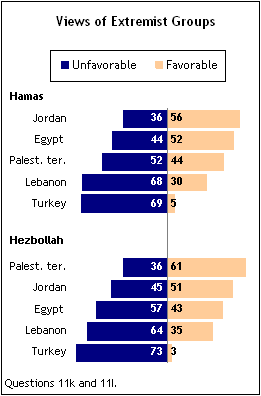
 Across predominantly Muslim nations, there is little enthusiasm for the extremist Islamic organizations Hamas and Hezbollah, although there are pockets of support for both groups, especially in the Middle East.
Four years after its victory in Palestinian parliamentary elections, Hamas receives relatively positive ratings in Jordan (56% favorable) and Egypt (52%). However, Palestinians are more likely to give the group a negative (52%) than a positive (44%) rating. And reservations about Hamas are particularly common in the portion of the Palestinian territories it controls — just 37% in Gaza express a favorable opinion, compared with 47% in the West Bank.
A survey conducted May 18 to June 16, 2009 by the Pew Research Center’s Global Attitudes Project also finds limited support for the Lebanese Shia organization Hezbollah.1 While most Palestinians (61%) and about half of Jordanians (51%) have a favorable view of Hezbollah, elsewhere opinions are less positive, including Egypt (43%) and Lebanon (35%). As with many issues in Lebanon, views of Hezbollah are sharply divided along religious lines: nearly all of the country’s Shia Muslims (97%) express a positive opinion of the organization, while only 18% of Christians and 2% of Sunni Muslims feel this way.
Meanwhile, Turks overwhelmingly reject both groups — just 5% give Hamas a positive rating and only 3% say this about Hezbollah. There is also little support among Israel’s Arab population for either Hamas (21% favorable) or Hezbollah (27%). Outside of the Middle East, many in Pakistan, Indonesia and Nigeria are unable to offer an opinion about these groups.
Lukewarm support for extremist groups among Muslim publics is consistent with other Pew Global Attitudes findings in recent years, which have shown declining public support for extremism and suicide bombing among most Muslim populations. The same surveys have also found decreasing confidence in Osama bin Laden. In addition, a 2009 Pew Global Attitudes survey in Pakistan — a country currently plagued by extremist violence — found growing opposition to both al Qaeda and the Taliban.
Little Enthusiasm for Most Muslim Leaders
There is limited enthusiasm for most of the Muslim political figures tested on the survey, with the exception of Saudi King Abdullah, who is easily the most popular. In Jordan (92%) and Egypt (83%) for example, large majorities say they have confidence that King Abdullah will do the right thing in world affairs. The king receives quite positive ratings outside the Middle East as well, especially in the largely Muslim Asian nations Pakistan (64%) and Indonesia (61%). However, the Saudi monarch does not receive high marks everywhere — only 8% of Turks voice confidence in him. And overall his ratings are less positive than they were in 2007.
Hezbollah leader Hassan Nasrallah receives less positive reviews. Only 37% of Lebanese overall express confidence in Nasrallah; however, the country’s Shia community shows almost unanimous confidence in him (97%). He also receives relative high marks in the Palestinian territories, and especially in the West Bank, where 71% say they think he will do the right thing in international affairs.
Confidence in Palestinian Authority President Mahmoud Abbas has declined since 2007, especially in the neighboring countries of Egypt (67% confidence in 2007; 33% in 2009) and Jordan (53% in 2007; 33% in 2009). His ratings have dropped slightly among Palestinians overall (from 56% in 2007 to 52% in 2009); however, they have declined markedly among Gazans, falling from 69% to 51%.
Even before their disputed elections last year, both Afghanistan President Hamid Karzai and Iranian President Mahmoud Ahmadinejad were generally unpopular among most of the Muslim publics surveyed. Ahmadinejad’s highest ratings are in the Palestinian territories (45% confidence) and Indonesia (43%), although even among these publics fewer than half express a positive view of his leadership. There is no country in which even 40% express confidence in Karzai, and in Pakistan (10%), Turkey (7%) and Lebanon (7%) one-in-ten or fewer hold this view.
As mentioned previously, ratings for al Qaeda leader Osama bin Laden have generally declined in recent years, and he receives little support among most Muslim publics. However, about half (51%) of Palestinians express confidence in him and in Nigeria, a 54%-majority of the country’s Muslim population say they are confident in bin Laden’s leadership. In Pakistan, where many believe bin Laden is now hiding, only 18% express confidence in him, although 35% do not offer an opinion. Very few Turks (3%) or Lebanese (2%) express support for the terrorist leader.
Across most of the 25 nations included in the spring 2009 Pew Global Attitudes survey, U.S. President Barack Obama received positive reviews, although this was less true in predominantly Muslim countries. Even so, his ratings were consistently higher than those of his predecessor, George W. Bush, and in some cases higher than for the Muslim leaders included on the survey. For example, only 33% in Turkey have confidence in Obama, but this is still more support than Abbas, Nasrallah, Abdullah, Ahmadinejad or Karzai receive. And the American president is quite popular among some largely Muslim publics, especially in Indonesia, where he spent several years as a child: 71% of Indonesians voice confidence in him. Obama is also popular among Nigerian Muslims (81%), Israeli Arabs (69%), and Lebanese Sunnis (65%).
Sunni-Shia Conflict
There is a widespread perception among Muslims that conflict between Sunnis and Shia is not limited to Iraq’s borders. In nine nations, Muslim respondents were asked whether the tensions between Sunnis and Shia are limited to Iraq or are a growing problem in the Muslim world more generally, and in seven of those nations, a majority of Muslims say it is a broader problem.
This is a rare point of agreement among Muslims in Lebanon, a country that has experienced considerable sectarian conflict for decades. Overall, 95% of Lebanese Muslims say Sunni-Shia tensions are a broad problem in the Muslim world, including 99% of Sunnis and 91% of Shia.
Most Pakistani, Egyptian, Jordanian and Nigerian Muslims also see a general problem that is not limited to Iraq. Israel’s Muslim minority community is roughly divided on this question — 42% say it is a more general problem, while 38% feel it is limited to Iraq. Indonesia is the outlier on this question — 25% of Indonesian Muslims say Sunni-Shia tensions are a general problem, while almost half (47%) think it is essentially a problem for Iraq (28% offer no opinion).
Lebanon’s Growing Divide
On several measures, the already large divides between Sunni and Shia in Lebanon are growing even wider. For instance, in 2007 94% of Sunnis and 57% of Shia expressed confidence in Saudi King Abdullah; in 2009, 94% of Sunnis and only 8% of Shia hold this view.
A similar example is evident in attitudes toward Hamas. Although it is a predominantly Sunni organization, Hamas has grown from generally popular among Lebanese Shia in 2008 (64% favorable) to almost universally popular in 2009 (91%), while Sunni support for the group has gone from low (9%) to almost nonexistent (1%).
Notably, views of the U.S. have grown more polarized, as the result of a shift of opinion among Lebanese Sunni. Positive attitudes among Sunnis have grown from 62% in 2008 to 90% in 2009. However, only 2% of Shia Muslims currently express a positive opinion of the U.S., barely an improvement from last year’s 0%.
Also of Note:
* Many Muslims are convinced that there is a struggle in their country between groups who want to modernize the nation and Islamic fundamentalists. More are convinced of the existence of such a struggle in Lebanon (55%), Turkey (54%) and the Palestinian territories (53%) than elsewhere.
* Muslim publics overwhelmingly support educating girls and boys equally. More than eight-in-ten in Lebanon (96%), Israel (93%), Indonesia (93%), Turkey (89%), Pakistan (87%) and the Palestinian territories (85%) say that it is equally important to educate girls and boys.
* In Arab nations, attitudes toward Jews remain extremely negative. More than 90% of Egyptians, Jordanians, Lebanese and Palestinians express unfavorable views toward Jews. Only 35% of Israeli Arabs, however, express a negative opinion. Pewresearch

Leave a Reply
You must be logged in to post a comment.