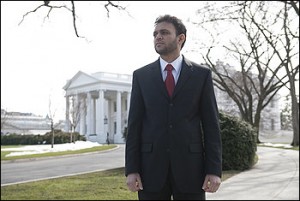
By Scott Wilson
Rashad Hussain, President Obama’s new special envoy to the Organization of the Islamic Conference, was an avid high school debater in Plano, Tex., where he grew up.
His debate partner and best friend was a classmate named Josh Goldberg, meaning that at the end of many tournaments, the judge would announce “Goldberg-Hussain” as the cultural odd couple who had won the argument. “People got a kick out of it,” Hussain said in a recent interview. “We joked that one day we would have the solution to the peace process.” The two remain close friends.
In his new position, Hussain, who is both a Koran scholar and an ardent North Carolina Tar Heels basketball fan, will be responsible for helping to bridge another cultural divide — the one in U.S. relations with Muslims inside and outside the nation’s borders.
Since taking office, Obama has adopted an approach to broaden the ways in which the United States engages the Islamic world, moving from a policy focused mostly on counterterrorism to one that includes partnerships with Muslim countries and communities in education, health, science and commerce.
Hussain, 31, will be the face of that policy in Jiddah, Saudi Arabia, where the Islamic Conference has it headquarters, and in the other capitals of its 56 member countries. His is an appropriately young face for an American representative to the world’s 1.6 billion Muslims, the majority of whom are younger than he is.
At a time when the United States is fighting two wars in Muslim nations and defending itself against an enduring terrorist threat, changing perceptions will take time. “The challenge is to continue to communicate that this is a long-term process,” Hussain said. “Sometimes the challenge becomes that people want to focus exclusively on the political issues, issues that this administration is working very diligently to solve.”
Hussain’s father, a mining engineer, moved from Bihar, India, to Wyoming in the late 1960s. A few years later, during a visit to India, he married Hussain’s mother, now an obstetrician in Plano.
The family prayed regularly in a mosque not far from the church-heavy city. At about the time he began middle school, the Persian Gulf War began and, as he recalled, “it was not the easiest time to be named Hussain.” But he said he encountered very little religious persecution during a childhood that featured study, prayer and basketball — a passion he shares with the president. Hussain said it is his “dream” to play in one of Obama’s pickup games.
He graduated from the University of North Carolina at Chapel Hill, then enrolled at Harvard University to pursue a master’s degree in Arabic and Islamic studies. An internship after his first year of graduate school with Rep. Richard A. Gephardt (D-Mo.) cemented his interest in government, and he returned after completing his degree to work on the House Judiciary Committee and was there on the morning of the attacks of Sept. 11, 2001.
“I experienced firsthand being evacuated from the building, not knowing what was going on, seeing the twin towers burning on TV as soon as I got into work, not knowing . . . whether there was a plane heading for the Capitol,” he said. “I very much experienced the terror on that day myself.”
In the following days, he said, he experienced a “whole set of feelings,” from the initial fear of attack to worry about discrimination against American Muslims. He said he found that compassion, broader than the pockets of persecution, is often overlooked by Muslims here and abroad.
“A lot is made about American misperceptions about Muslim communities, but there’s a lot of misperceptions that Muslim communities have about the United States,” he said. To counter such misunderstandings of Muslim culture, Hussain cited his wife, whom he said “breaks down a lot of the misperceptions of women in Islam.” Isra Bhatty, a Yale Law School student currently on a Rhodes scholarship, wears the hijab and is an epic Chicago Bears fan.
Hussain left Capitol Hill to attend Yale Law School. While there, he criticized the trial of Sami al-Arian, a University of South Florida professor, as “politically motivated persecution.” Arian was accused of aiding the Palestinian Islamic Jihad movement, a U.S.-designated terrorist organization. Hussain, who did not criticize the charges against Arian, was on a civil liberties panel with Arian’s daughter when he made the comment. A jury acquitted Arian on some charges and deadlocked on others; he eventually pleaded guilty to one count of conspiracy.
“My extensive writings on this topic make it clear that I condemn terrorism unequivocally in all its forms,” Hussain said. “I’d be happy to put that against one sentence from 2004 that I believe was taken out of context.”
After the 2008 election, Hussain was recruited to the White House counsel’s office by Cassandra Butts, a fellow Tar Heel and Obama’s former Harvard Law classmate. He has worked there on national security and new-media issues and helped inform the administration’s Muslim outreach efforts.
Ben Rhodes, Obama’s chief foreign policy speechwriter, sought Hussain’s counsel last year as he drafted the president’s Cairo address. Hussain said his advice concerned the contributions Muslims have made to American society and the context behind some of the religious passages. Hussain has memorized the Koran. He prays daily, often in a room in the Eisenhower Executive Office Building reserved for all faiths.
Hussain traveled in the Middle East after Obama announced his appointment during a Feb. 13 videoconference at the U.S.-Islamic World Forum in Doha, Qatar. His approach, Hussain said, will be to emphasize to Muslim countries what “America stands for,” including through the partnerships.
“It’s clear that we’re not going to agree on every single issue,” Hussain said. “Our job will be to try to maximize our areas of agreement and work through our areas of disagreement and come to the best policy.”

Leave a Reply
You must be logged in to post a comment.