Can Lebanon Afford its Current Fixed Exchange System?

By Ghassan Karam, Special To Ya Libnan

There is hardly an opportunity given to individuals connected to the Ministry of finance, the Central Bank or the commercial banking system where they do not stress the substantial volume of funds that has been flowing into the country. The implication being that these capital flows are a vote of confidence in the stability, dynamism and confidence in the Lebanese economy. What they conveniently forget to declare is that capital flows are ultimately determined by a thorough analysis of the relative safety of the country in question relative to the risk premium that it is willing to pay. Very simply stated this means that any level of risk becomes attractive at a certain price.

Lebanon has had no problem of attracting capital flows into the country for the very simple reason that the Lebanese banks are paying an interest rate that is above the world interest rate. So the question should be why is Lebanon condoning this misguided policy of in essence subsidizing the deposits that are willing to flow into Lebanon and what is more important is the question of whether such a policy is sustainable. Can tiny Lebanon afford to pay a rate that is above the world rate in order to attract funds that it does not need.

It appears to this observer that the Lebanese commercial banks are willing to pay above that of the rest of the world simply because it is profitable for them. How can that be so if they are not in need of these funds? The surprising answer to this quandary is the Lebanese central bank that is willing to absorb from its member banks their excess liquidity by issuing CD’s at a high interest rate. Such a policy is not sustainable in the long run and is actually damaging to the health of the Lebanese economy in the long run. The current policy attracts funds that are not needed by paying these funds a premium that makes such transactions inefficient. So why does Lebanon engage in these policies that wind up in inflicting pain on the Lebanese economy? Again the answer is rather simple. The Lebanese governments’ continued need for more and more sovereign debt dictates growing the economy. But unfortunately whenever a country decides to have a fixed exchange rate system coupled with perfectly mobile capital flows then its monetary policy option becomes totally ineffective. In such a case the government will have no choice but to apply the expansionary fiscal option delivered through deficit spending. But why does the government feel the need to use deficit finance when it already suffers from one of the highest debt/GDP ratios in the world? You guessed it; the government needs to grow the economy so that it might borrow some more in order to service its sovereign debt. Under normal circumstances the above policy will eventually get the economy back to equilibrium but only once it adopts the world interest rate. And this is the rub. If Lebanon is to adopt the world interest rate then the flow of funds into the country will be greatly diminished.

A quick review of the theoretical four available options should help us get a clear understanding of this problem. Given that capital flows are perfectly mobile then Lebanon must choose from among the following policy options:

……………………………….Fixed Exchange Rates………………….. Flexible Exchange Rates

Fiscal Policy……… Effective if Fiscal is deficit finance                              Totally Ineffective                                                                     ………………………+ Monetary growth at world rates

Monetary policy ……Totally Ineffective                                         Effective if used with Fiscal based on X
X: Exports due to lower exchange Rate
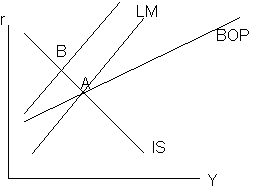
Based on the theoretical options as described in the above matrix Lebanon should consider moving away from the Fixed Exchange system currently in force and should move towards a flexible system. That will make repayment of the current sovereign debt easier .will give more power to the monetary authorities and will rationalize capital flows into the country.

Discussion

View Comments for “Can Lebanon Afford its Current Fixed Exchange System?”


Please respect the community. Comments that contain personal attacks or inappropriate language will be removed.
  • http://RottenLebaneseSectarianSystem Sebouh Akharjalian

    Fixed versus Flexible Exchange rate systems.
    First of all, do you think the enormous profits the alpha banks in Lebanon reaped during these years are all due to the Fixed exchange system.
    True Flexible exchange rates based on the matrix above is more suitable and healthy to the economy in the long run then then the Fixed exchange rate system.
    However, we must also take into consideration that we live in a politically unstable country and any major exchange rate shits could have a devastating effects much similar to the days of 1980s and early 1990s.
    Now I understand that this current fixed exchange rate is highly unsustainable, but I’m afraid there are no straight answers to our ongoing problems.
    The scenario that you have presented us reminds me of US monetary policy. The weak dollar policy can increase US exports to other less competitive countries and further stimulate the economy. This policy also has a drawback which is the inflation. Therefore, it is very hard to find a balance between the Fiscal and Monetary policy.

  • http://RottenLebaneseSectarianSystem Sebouh Akharjalian

    Fixed versus Flexible Exchange rate systems.
    First of all, do you think the enormous profits the alpha banks reaped during these years are all due to the Fixed Exchange rate system.
    True Flexible Exchange rates based on the matrix above is more suitable and healthy to the economy in the long run then the current Fixed Exchange rate system.
    However, we must take into consideration that we live in a politically unstable country and any major exchange rate shifts could have a devastating effects much similar to the days of 1980s and early 1990s.
    Now I understand that this current fixed exchange rate regime is highly unsustainable, but I’m afraid there are no straight answers to our ongoing problems.
    The scenario that you have presented us reminds me of US monetary policy. The weak dollar policy can increase US exports to other less competitive countries and further stimulate the economy. This policy has a drawback which is the inflation. Therefore, it is very hard to find a balance between the Fiscal and Monetary policy.

  • http://rationalrepublic.blogspot.com Ghassan Karam

    Sebouh,
    The real problem in Lebanon is the national debt. Had it not been for the national debt then a fixed exchange system ambined with perfect capital mobility would work just fine because then the fiscal policy would apply pressures on the interest rate to rise and the central bank would counter that by increasing money supply. This is not working in Lebanon because the monetary for two reasons: Fiscal authorities are budgeting for a deficit only as a result of the sovereign debt. It just is not a productive deficit and then the response by the BDL for the high interest rates is muted. A healthy economy cannot keep subsidizing all the artificial capital inflow into the country. So what do they wind up in doing? They are forced to buy the extra liquidity from the commercial banks at high rates so that the banks can afford to pay the high rates in the first place!!!
    Flexible Exchange rates would deal with the issue by forcing discipline. The Lebanese government should cut its deficit, just like the Greek government, and not expand it. It should use its resources to pay offthe debt. The natural rate of growth in the economy, if all of these billions had been invested productively and efficiently; would generate adequate returns to service the debt. In this case a monetary expansionary policy would apply downward pressure on the exchange rates which will be counter balanced by the expantionary fiscal policy that would be triggered by the lower exchange rate. The net result would be to end up with substantial expansion and the same rate that was prevalent when the process started. It would be a real exchange rate in the sense that it would be determined by the world interest rate instead of the artificial one that is currently used.

  • http://RottenLebaneseSectarianSystem Sebouh Akharjalian

    First of all, how can we ask the same individuals that have caused the financial catastrophe in the first place.
    Now we all agree that the fundamental problem in Lebanon is our soaring national debt.
    Let us ask this question when and how did this debt become a dilemma.
    The answer shortly after 1993 under the government of former Prime minister Rafic Hariri and BDL at that time were trying desperately to attract foreign capital to rebuild this war torn country. Back in the Mid 90s the BDL was offering 2 year TBS in Lebanese Lira at an astronomical level of 43% and it is widely believed that only handful of elite politicians and foreign investors benefited from this lucrative adventure.
    This policy ballooned our national debt and by late 1999 our GDP/DEBT ratio surpassed allarming level of %100.
    Moreover, as you can see all the past and present governments and the BDL including have all violated rule number one in economics. “There is no free lunch”.
    Finally, I think the Lebanese government cannot cut its current deficits at the moment because there is no political will. On the other hand, Prime Minister Giorgios Papandreou’s austerity policy plan is imposing huge cuts in jobs, wages, social programs and pension to make the working class pay for the soaring state debt owed to the international bankers.

  • http://RottenLebaneseSectarianSystem Sebouh Akharjalian

    In addition, the rampant corruption and the continuous waste of recources in most public institutions back then and now has further contributed to this staggering debt levels.

blog comments powered by Disqus
ArabicChinese (Simplified)EnglishFrenchGermanItalianPersianRussianSpanishTurkish

Translate Ya Libnan


Advertise With Us


Follow Ya Libnan on Twitter @ya_libnan

Recent Comments

Ya Libnan Café Ya Libnan Online Shop