Ghajar residents say they are Syrian

ghajar protest

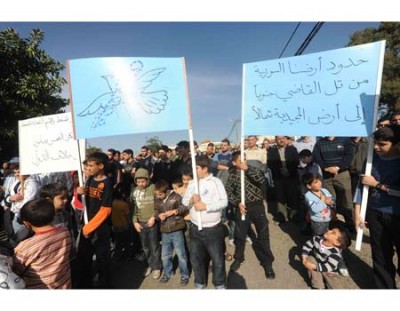
The residents of Ghajar a village in south Lebanon protested over news that Israeli troops planned to withdraw from the northern part of the village which Israel occupied during the 2006 war with Hezbollah
“They will divide our people, cut families in two,” the villagers chanted.
Secretary for the town council Hussein Khatib insisted that Ghajar residents have no connection with Lebanon. “We would be like refugees in Lebanon,” Khatib said.
He added: The town’s division was “just like separating the son from his father or the daughter from her mother.”
“They will divide our people, cut families in two,” the villagers chanted during the protest .
He said dividing the village would leave 1,700 people living in the Lebanese-controlled part and 500 on the Israeli-controlled side.
The northern part of Ghajar is in Lebanon and the rest in the Golan Heights which Israel seized from Syria in 1967 and later annexed in a move not recognized by the international community.
Unlike the Druze of the Golan Heights , Ghajar residents who are members of the Alawite Islamic minority , accepted Israeli nationality when the Golan was annexed in 1981.
Khatib said that even though residents accepted Israeli citizenship in 1981, “our village’s identity is Syrian.”
Ghajar is Syrian, it’s people are Syrian and its land is Syrian,” Khatib said.

Discussion

15 comments for “Ghajar residents say they are Syrian”

  1. Why doesn’t the government in this case just give it in and save Lebanon the hassle? Seeming as they’re so proud of their Syrian identity, let the Ghajar Municiplaity officially be part of the occupied Golan Heights.

    Posted by Louay Faour | December 11, 2009, 7:58 pm
  2. The inhabitants of Ghajar are cleary Syrian, however instead of letting this (UN recognised) Lebanese village be ceded to the Israeli occupied Golan Heights, we must lay claim to it untill the Chebaa Farms are returned to Lebanon, which is Lebanese, and so are the landowners who were driven out. Israel won’t just return the Chebaa Farms to Lebanon, but they might if we agree to recognise Ghajar as part of the occupied Golan Heights and retract our claim to it. I think Ghajar should be used as a negotiating tool.

    Posted by lawrence | December 12, 2009, 12:40 am
  3. I understand Lawrence, but do you really think Israel is going to give up on the Golan Heights now? Its to much for them, they need a base to attack Syria in the future or Hezballah (God forbid). Even the Shebaa Farms in some cases are classified as Syrian, its a jumbled story and Israel is claiming it all for Syria, while Syria is saying its Lebanese.

    Posted by Louay Faour | December 12, 2009, 11:50 am
  4. And by the way, Ghajar is located IN the Shebaa farms, and seeming as the Shebaa farms are ours, how does that make the residents of Ghajar Syrian?

    Posted by Louay Faour | December 12, 2009, 11:52 am
  5. Very likely the village expanded illegally into Lebanese territory.

    Posted by Kheireddine | December 12, 2009, 12:02 pm
  6. As far as I am aware Louay Faour, the Shebaa Farms and Ghajar are seperate, but are both attached to the Golan. However I believe instead of retracting our claim to Ghajar, as you suggested, I believe we should claim it so long as Israel occupies Lebanon (the Chebaa Farms). You made a good point, Israel is not interested in returning the Farms, but if we cede Ghajar to them, we have just gave away a card. Lebanon is a small country, we can’t afford to give away land for nothing, especially land recognised as Lebanese by the UN. Israel never does the right thing because it is right, if they are ever interested in peace with Lebanon, they will only give back the Chebaa Farms for something to benefit them. That could be Lebanon retracting it’s claim to the small village of Ghajar and the adjasant feilds in the occupation, and it being recognised by the Lebanese government as land in the occupied Golan Heights, which is clearly, as you said, never going to be returned to Syria. So if we have any hope of seing our land returned, we must keep Ghajar as a negotiating card. The inhabitants of Ghajar are Syrian because they carry Syrian passports, and as you said, they feel so strongly about their identity.

    Posted by lawrence | December 12, 2009, 12:47 pm
  7. To be proud of ones identity/nationality, what a shame.
    A line drawn in the sand separates families or maybe in this case the line had to be drawn over some stone a bit of sand and the most beautiful piece of dirt on earth unless you compare Lebanon to Australia 
    Who cares about villages, borders and everything else that is a problem in the middle east, aren’t you people sick of the same story over and over and over again.

    Posted by Ask my mum | December 14, 2009, 7:55 am
  8. Lawrence, I couldn’t agree more with you.

    Posted by Louay Faour | December 14, 2009, 11:53 am
  9. ASK MY MUM? The problem evolves around the occupied Golan Heights, which is Syrian, but the Shebaa farms are in it. Lebanon doesnt have much of a problem with Israel in terms of land and territory as it use to back from 1982-2000. Its Syria which is in crisis, but Israel took away the northern Ghajar again after the 2006 conflict. So if theres anyone to blame here, its Israel.

    Posted by Louay Faour | December 15, 2009, 11:46 am
  10. The Shebaa farms are recorded as Syrian by the UN.
    Lebanon should negotiate with Syria for a formal transfer of rights to the area to Lebanon. Israel will then be more than willing to give them to Lebanon within hours.
    No more “resistance” excuses from Hesbollah, the occupying Iranian and Syrian force in Lebanon.

    Posted by George | December 17, 2009, 9:16 pm
  11. I am NOT trying to be steryeotypical or disisive here, but why is it that every ‘Christian’ person here leaves a negative comment about Hezballah, lol. But George, dont the UN recognize it as Lebanese? Because of that, Israel isnt negotiating (they want a base for any future attacks on Hezballah).. Bad yes, but Syria should engage more and say it’s Lebanese, because to be honest its in the Golan Heights yet the Lebanese government asks for it.. ?

    Posted by Louay Faour | December 18, 2009, 1:53 am
  12. Louay: According to the UN, the Shebaa farms are in Syria. If Syria recognizes Lebanon sovereignty on the farms, it should officially say so.
    Instead they say that this is an issue to be resolved after Israel returns the Golan. That’s the only reason that Israel keeps them. The Shebaa farms don’t have a strategic value on a potential future war which I hope never happens again.

    Posted by George | December 22, 2009, 11:25 am
  13. George: I’ve heard wrong then, because I heard the UN recognized it as Lebanese. But anyhow, Syria does say it’s for Lebanon… And yes, we all hope another war doesn’t happen again.

    Posted by Louay Faour | December 23, 2009, 7:49 pm
  14. syria still doesn’t recognize lebanon’s independence, so what difference does it really make?

    the interests of the people of ghajar would be to not divide the town, and to remain under israeli rule, for economic and religious reasons, even if israel makes a peace treaty with lebanon or syria. as israeli citizens, how could israel just hand them over to either country? and technically, the area was syrian prior to 1967, so it must first be returned to syria, if at all, before any dispute with lebanon can be settled.

    Posted by tom | December 25, 2009, 6:56 pm
  15. Tom: Syria, for your information, does recognize Lebanon’s independence. If it didnt, no-one would have made the slightest effort to co-operate. It might wish that it stayed longer in the Beqaa valley, but thats now over and done with. I agree that it was originally Syrian, but then again, why would Syria tell Israel its Lebanon’s?

    Posted by Louay Faour | December 25, 2009, 9:36 pm

Post a comment

Please respect the community. Comments that contain personal attacks or inappropriate language will be removed.

Advertise With Us


Follow Ya Libnan on Twitter @ya_libnan
Looplit - Designer Accessories
Ya Libnan Café Ya Libnan Online Shop