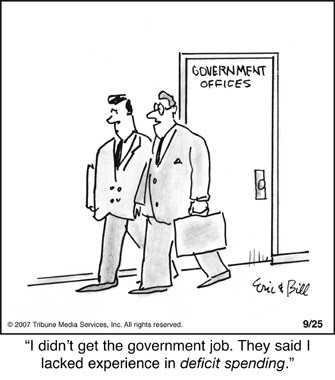
Default Debt Indicators

By Ghassan Karam, Special to Ya Libnan

The subject of national debt, its burden or its sustainability has always led to heated debates and recriminations determined by ones political views. As a general rule those that support March 14 have a more positive view of Lebanon’s ability to finance its future needs while those that belong to the opposition appear to have a dim view both of the debt and its implications.

But one would have expected all observers to take a position on this all important issue based on certain objective criteria instead of the normative subjective lines of thinking that is being employed.  The eventuality of default on national debt becomes unavoidable ones a set of thresholds has been crossed irrespective of the political ideology of the ruling party in the country in question. The likelihood of declaring default is very much affected by the solvency and the degree of liquidity that the country in question enjoys. There is no doubt that geopolitical developments also play a role. But even when political instability contributes to the high likelihood of a default it does that by affecting the fundamental macroeconomic variables. That is why we intend to present a summary of the most important indicators that a recent purely objective empirical study has shown to be the most common indicators that a sovereign debt crisis is very highly likely. The study was published as an IMF Working Paper and was co authored by Mr. Nouriel Roubini whose views and analysis of the recent global economic crisis has catapulted him to the top of his profession.

The following are the 10 variables that are usually closely associated with a sovereign debt crisis:

(1)Total External Debt/GDP ratio above 49.7%

(2)Short Term debt/Reserves ratio of over 130%

(3)Real GDP growth

(4)Public External Debt/Government revenue ratio of over 214%

(5)CPI Inflation

(6)Presidential election cycle

(7)US Treasury Bill rate

(8)Current Account balance + short term debt/Foreign Reserves ratio

(9)Exchange Rate overvaluation of more than 48%

(10) Exchange Rate volatility

The above 10 indicators provide a highly reliable snapshot about an economy irrespective of its size or political orientation. The above list gives the analyst an idea about a sovereign’s ability to pay, its liquidity and its exchange rate risk. No one variable by itself is capable of predicting correctly the default risk associated with a country but a number of these indicators, if they breach their threshold would create a crisis-dynamic that would be difficult to dismiss.

If we are to take a quick look at the above indicators as they apply to Lebanon then it becomes very clear that Lebanon is in serious violation of (1); (2); (4);(7); and (9) while (6) and (10) can be deemed not to be applicable. Relatively negative indicators are (5) and (8) even when gold is included. This leaves (3) as the only slightly positive indicator.

This is an unambiguous record that shows a high probability of a debt crisis which will manifest itself either in a default or a restructuring of debt.

Discussion

8 comments for “Default Debt Indicators”

  1. This is exactly what capitalism and globalization are doing to Lebanon, the Third World and other developping countries, creating economic crisis leading to poverty and consequently seeking loans from IMF with high interest rates sinking the country furthermore into huge deficit. The IMF is nothing but a international political cover-up aiming solely at expanding the capitalist empire.Introducing the US currency to Lebanons banking markets was first ingredient to a recipe of economic political and religious warfare on the Lebanese arena.

    Posted by Dalal | January 3, 2010, 12:39 pm
  2. Ghassan, what would Lebanon have to do to attempt to pay off the debt… gold, taxes like you have mentioned in a previous article, oil which many are saying could be discovered very soon…?

    Posted by Louay Faour | January 3, 2010, 12:51 pm
  3. Dalal,
    Some of the brightest minds in the world have been strong critics of the IMF but to go so far and call it a political cover is rather silly. A political cover for whom?

    Louay,
    One can safely make a comparison between an individual who has borrowed beyond his/her capacity and a country whose external national debt has grown to a crisis level.
    The possible scenarios are often limited to either defaulting on at least part of the debt, agreeing to restructure the debt or finding a substantial new form of income.
    I believe that Lebanon is at a stage where servicing the debt is extremely difficult. a long period of Extended growth and stability could combine to allow Lebanon to meet its debt obligations. How likely is that and how socially costly? That is why I am calling for a serious study of all the alternatives.

    Posted by Ghassan Karam | January 3, 2010, 4:54 pm
  4. Ghassan I did not come to this conclusion by myself.. we did a research on poverty at Uni. and we found out that the World Bank and the IMF are responsible for what is happening around the world in Asia, Africa and the rest. Free trade was another cruel plot against developping countries. I don’t believe you called this comment silly, I believed you knew about this since you’re such a good journalist on economics…hmmm I think you better do some good hard research.. am sure at the end you would come to the same conclusion.. the WB and the IMF are politically covering up for imperialism. You have to study the way these systems work. let’s call it a challenge. See why the brightest minds criticise it.

    Posted by Dalal | January 4, 2010, 3:01 am
  5. Dalal I agree with your comment that both WB and IMF have proven to be a cover up for imperialist expansion. Although this argument might sound controversial to others.
    The WB and IMF have long been criticized by non-governmental organizations and academics, including its former Chief Economist Joseph Stiglitz. Critics argue that the so called free market reform policies which both of these respective institutions advocate are often harmeful to economic development if implemented badly, too quickly(shock therapy), in the wrong sequence or in week, uncompetitive economies.
    To put it short, during the 1990s the WB and IMF forged the Washington Consensus, policies which included deregulation and liberalization of markets, privatization and the downscaling of government. Some analysis shows that the WB and IMF have actually increased poverty and have been detrimental to the environment, public health and cultural diversity. Some critics also claim that these organizations have consistently pushed a neoliberal agenda, imposing policies on developing countries which have been damaging, destructive and anti-developmental.
    Finally, it has been suggested that both the WB and the IMF are an instrument for the promotion of US or Western interests in certain regions of the world.
    From this context I agree that both the World Bank and IMF are a cover for imperialist expansion. I hope Mr. Ghassan agrees with me in this respect

    Posted by Sebouh Akharjalian | January 4, 2010, 12:34 pm
  6. Sebouh this unfortunately is very true ..even Foreign Aid is used as a channel of wealth by imperial powers of the world to benefit only the few groups of billionaires in western countries to become richer while the masses of populations in the Third World sink deeper into poverty living on less than a $1 a day.
    TTW nations receiving aid take on policies that depress local production which means these countries become dependent on western aid for their very existence, losing completely any self-sufficiency in producing their own food.

    Posted by Dalal | January 4, 2010, 4:40 pm
  7. Sebouh/Dalal,
    I have been a critic of the IMF, WTO, World Bank and many other global institutions. That is not the bone of contention.
    These institutions are a product of a system and no system will create institutions that are not going to be designed to further its goal. The world is essentially a capitalist system and so these institutions will promote capitalism.
    It is crucially important not to fall into the trap of accepting the system and rejecting its institutions. That is a logically indefensible position. There is nothing wrong in rejecting the system and all its institutions or demanding some reforms in both the system and its institutions .
    To call the IMF and the other gloabl institute a cober is what I am objecting to. THey are part and parcel of the system and not a result of a conspiracy. No group of individuals came up with the idea of creating the IMF in order to take advantage of some countries. The IMF was created in order to promote the economic interests of the world after WWII. One of the pressing issues at the time was that of exchange rates and competitive devaluations after the collapse of the gold standard. For better or worse the IMF was created to help countries restore stable exchange rates through a dollar -gold standard. Whenever countries ran huge deficits on their current accounts and could not attract any capital flows then there were tremendous pressures on these countries to devalue. The IMF helped them do that. After Nixon demonitized gold and many adopted either a clean float, a dirty float or decided to apply exchange control then the role of the IMF changed.
    The IMF was not created to promote equity. If we do not like some or even all what it does then we have to call for the creation of a new system all over the world. To keep the current paradigm and speak of the IMF as if it was created in a vacuum to frustrate the goals of economic development is not logical. Even Stiglitz, the enfant terrible of mainstream economics does not make any such accusations as to call it a cover up.His only recommendation, and it is an important one, in his book “Making Globalization Work” is not to dismantle the IMF but to reallocate the voting rights so as to make it more democratic and more in line with the current economic realities. So he does not advocate throwing the baby with the dirty water. He is in essence asking the Western countries to give a greater vote to the BRIC countries.We are already moving in that direction.
    Remember that one is free to reject the IMF totally but then one must reject the systemalso. Call for a new global paradigm if that is your inclination but don’t call the IMF a cover when it is part and parcel of the system.

    Posted by Ghassan Karam | January 4, 2010, 6:50 pm
  8. Ghassan these systems throwing millions of people in extreme poverty around the world… these systems stink and since you are admitting they’re designed to serve the capitalist empire the US why are you defending their institutions which are proving to have failed in their major objectives of assisting poor countries kick start their weak economies….Yes the systems are designed to expand capitilism and capitalism only there is nothing whatsoever good or benefitial to any nation except the US. The systems are cruel and inhumane and no reforms can change their ugly intentions .. sorry

    Posted by Dalal | January 5, 2010, 2:41 am

Post a comment

Please respect the community. Comments that contain personal attacks or inappropriate language will be removed.

Advertise With Us


Follow Ya Libnan on Twitter @ya_libnan
Looplit - Designer Accessories
Ya Libnan Café Ya Libnan Online Shop