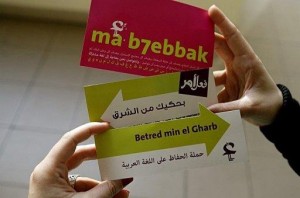
Campaign to save the Arabic language in Lebanon

Arabic in the web-friendly Latin script


By Hesham Shawish

When Randa Makhoul, an art teacher at a school in Beirut, asks her students a question in Arabic, she often gets a reply in English or French.

“It’s frustrating to see young people who want to speak their mother tongue articulately, but cannot string a sentence together properly,” she said at the Notre Dame de Jamhour school in the Lebanese capital.

Mrs Makhoul is just one of several Lebanese teachers and parents who are concerned that increasing numbers of young people can no longer speak Arabic well, despite being born and raised in the Middle Eastern country.

She welcomes a government campaign to preserve Arabic in Lebanon, called “You speak from the East, and he replies from the West”.

“This campaign aims to raise awareness about the importance of protecting Lebanon’s official language,” says Amal Mansour, media spokeswoman at the Lebanese ministry of culture.

“We encourage the learning of foreign languages, but not at the expense of the country’s mother tongue.”

Polyglot country

Arabic is the official language of Lebanon, but English and French are widely used.
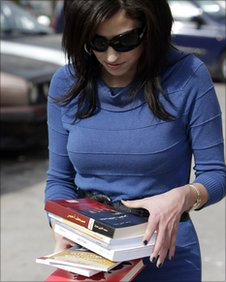
Most Lebanese youth speak a mixture of Arabic, French and English

Most Lebanese speak French – a legacy of France’s colonial rule – and the younger generation gravitates towards English.

A growing number of parents send their children to French lycees or British and American curriculum schools, hoping this will one day help them find work and secure a better future.

Some even speak to their children in French or English in the home.

“It’s sad no-one in our generation is speaking Arabic properly anymore,” says Lara Traad, a 16-year-old student at Notre Dame de Jamhour, one of Lebanon’s many French curriculum schools.

“I really regret that my parents did not concentrate more on developing my Arabic. It’s too late now, but maybe for the younger students in the country something can be done.”

Even with Arabic, there is a big difference between the classical, written form of the language and the colloquial spoken Lebanese dialect.

The classical language is almost never used in conversation – it’s only heard on the news, in official speeches, and some television programmes.

As a result, many young Lebanese struggle with basic Arabic reading and writing skills, and it is not uncommon for students as old as 16 or 17 to speak only broken Arabic.
Wider problem

The problem is seen in several parts of the Arab world where foreign schools are common – the UAE, Jordan, Egypt and most North African states.

Citing the wide gap between the formal language and its various colloquial forms within the Arab world, Egyptian philosopher Mustapha Safwaan once wrote that classical Arabic was theoretically a dead language, much like Latin or ancient Greek.

But language expert Professor Mohamed Said says classical Arabic is a unifying force in the Arab world.

“Classical Arabic is the language of communication, literature, science, philosophy, the arts – it is something that unites the Arab world,” says Prof Said, a senior Arabic language lecturer at London’s School of Oriental and African Studies.

According to Prof Said, colloquial dialects in the Arab world should not be seen as separate linguistic entities, but a continuance of the classical Arabic form.

Lebanon’s language campaign is the first of its kind to be launched by an Arab government.

The culture ministry organises talks in schools to raise awareness among pupils about the importance of protecting their mother tongue, and encouraging them to take pride in it.

Mrs Mansour, the ministry spokeswoman, says the government hopes that protecting the Arabic language in Lebanon will in turn protect the country’s identity and heritage.

Whether the initiative is enough to change how Lebanon’s youth communicate and express themselves is another matter. BBC

Discussion

View Comments for “Campaign to save the Arabic language in Lebanon”


Please respect the community. Comments that contain personal attacks or inappropriate language will be removed.
  • karim

    I guess the authorof this article watned to grab some attention, so he started to exaggerate (understatement).
    “As a result, many young Lebanese struggle with basic Arabic reading and writing skills, and it is not uncommon for students as old as 16 or 17 to speak only broken Arabic.” i don’t believe this statement for one second, what a crack of kaka (no offense to the brazilian fans)

  • karim

    I guess the authorof this article watned to grab some attention, so he started to exaggerate (understatement).
    “As a result, many young Lebanese struggle with basic Arabic reading and writing skills, and it is not uncommon for students as old as 16 or 17 to speak only broken Arabic.” i don’t believe this statement for one second, what a crack of kaka (no offense to the brazilian fans)

  • Walid Khouri

    The problem is the Arabic language as it is not evolving. We speak Lebanese yet we cannot write Lebanese. We are stuck in the past akin an English speaking person is reading Shakespearean Old English. To write Arabic and speak Lebanese that is the problem.
    The Lebanese newspapers are trying to strike a balance with “loghat el jaraa’ed” but they are failing miserably.
    here is an example:
    Izhab men houna as opposed to ruuh men hon.
    Why can’t I write what I speak like in English?
    Also, the lack of vowels in the Arabic language is pathetic. The dependence on the marks like fatha, damme etc. is so archaic. Try to say the word Canada then write it as CNDA. Pathetic isn’t it?
    Also, why can’t we evolve like English or Turkish and use the Phoenician / Greek / Latin Alphabet instead of the Arabic script? Malta did it and they have a beautifully preserved Phoenician based language written in Latin Alphabet with some modifications.
    At last think about computerization and search engines. The last time I was in a bookstore searching for books about Suur the city I ended up with books about Suwar two words written the same way yet pronounced differently.
    No need to continue as you got my point… I think!

  • Walid Khouri

    The problem is the Arabic language as it is not evolving. We speak Lebanese yet we cannot write Lebanese. We are stuck in the past akin an English speaking person is reading Shakespearean Old English. To write Arabic and speak Lebanese that is the problem.
    The Lebanese newspapers are trying to strike a balance with “loghat el jaraa’ed” but they are failing miserably.
    here is an example:
    Izhab men houna as opposed to ruuh men hon.
    Why can’t I write what I speak like in English?
    Also, the lack of vowels in the Arabic language is pathetic. The dependence on the marks like fatha, damme etc. is so archaic. Try to say the word Canada then write it as CNDA. Pathetic isn’t it?
    Also, why can’t we evolve like English or Turkish and use the Phoenician / Greek / Latin Alphabet instead of the Arabic script? Malta did it and they have a beautifully preserved Phoenician based language written in Latin Alphabet with some modifications.
    At last think about computerization and search engines. The last time I was in a bookstore searching for books about Suur the city I ended up with books about Suwar two words written the same way yet pronounced differently.
    No need to continue as you got my point… I think!

  • Fadi Abboud

    oh well..i’m perfectly fine with it. plenty of other Arabic speaking countries in the middle east who will never let the Arabic language be forgotten.

  • Fadi Abboud

    oh well..i’m perfectly fine with it. plenty of other Arabic speaking countries in the middle east who will never let the Arabic language be forgotten.

  • Jamil

    Arabic is the fastest-growing foreign language taught in EU, US , China, and others

    Go figure!

  • Jamil

    Arabic is the fastest-growing foreign language taught in EU, US , China, and others

    Go figure!

  • Ask my mum

    Mates lets not stress, what we speak is the least of our problems. However I will say that Arabic is beautiful language and Lebanese is even better. Yalla etikil 3a alah

  • Ask my mum

    Mates lets not stress, what we speak is the least of our problems. However I will say that Arabic is beautiful language and Lebanese is even better. Yalla etikil 3a alah

  • Tony A

    walid, dude, you’re like cliff on Cheers my man. you’re full of awesome info man. good point too but, i think the reason we try to keep the ‘LOOGHA AL FOOS7A” is so that all people of all arab heritage can commonly read it cos if i try reading algerain, i don’t think i’d know what they’re saying.

    another thing is, and this is a very serious question.

    that picture in the article. is that Maria?? :) :) grrrrrrrooooowwlll

  • Tony A

    walid, dude, you’re like cliff on Cheers my man. you’re full of awesome info man. good point too but, i think the reason we try to keep the ‘LOOGHA AL FOOS7A” is so that all people of all arab heritage can commonly read it cos if i try reading algerain, i don’t think i’d know what they’re saying.

    another thing is, and this is a very serious question.

    that picture in the article. is that Maria?? :) :) grrrrrrrooooowwlll

  • maria

    yeeeee libon languages are changing, yalla soon you will add persian to your mix!

  • maria

    yeeeee libon languages are changing, yalla soon you will add persian to your mix!

  • Walid Khouri

    lol :D Maria too funny!!!

  • Walid Khouri

    lol :D Maria too funny!!!

  • Jamhour alumnus

    the school mentioned is College Notre Dame de Jamhour, my alma mater. Jamhour is a French Jesuit school. Two things: They emphasize French well above Arabic in all their classes, and they have done this for generations; Many students at Jamhour were born and raised in the West, and their parents have returned to Lebanon, so these kids are new to Lebanon, new to Arabic.

  • Jamhour alumnus

    the school mentioned is College Notre Dame de Jamhour, my alma mater. Jamhour is a French Jesuit school. Two things: They emphasize French well above Arabic in all their classes, and they have done this for generations; Many students at Jamhour were born and raised in the West, and their parents have returned to Lebanon, so these kids are new to Lebanon, new to Arabic.

  • Danny

    Most of your arguments can be applied against Persian or Hebrew, and yet these two languages seem to flourish.

  • Danny

    Most of your arguments can be applied against Persian or Hebrew, and yet these two languages seem to flourish.

  • Lebster

    Why would someone need an alphabet with musical notes, like fatha damma kasra? Reading na7awi is guessing half the time without them. Very weak alphabet, needs evolving.

  • Lebster

    Why would someone need an alphabet with musical notes, like fatha damma kasra? Reading na7awi is guessing half the time without them. Very weak alphabet, needs evolving.

  • Walid Khouri

    You are saying exactly what I am saying. Hebrew is spoken the same way it is written, the same goes for Farsi.
    If you read Farsi it is exactly like the spoken language. Write a speech in Arabic and try to speak it in a lecture if you can, it will sound like you are reciting the holly Koran.

  • Walid Khouri

    You are saying exactly what I am saying. Hebrew is spoken the same way it is written, the same goes for Farsi.
    If you read Farsi it is exactly like the spoken language. Write a speech in Arabic and try to speak it in a lecture if you can, it will sound like you are reciting the holly Koran.

  • http://www.polydromo.gr Roula Tsokalidou-Zakhem

    As a (socio)linguist academic and editor of a multilingual periodical on bilingualism (based in Greece) who has family relations in Lebanon, I am extremely interested in the issue of language in Lebanon. Indeed if the naturally spoken language in Lebanon is not the one in which school concepts are developed, since classical Arabic is the high variety, this creates a problem. If students cannot use the language of their natural communication at school, and have to acquire classical Arabic, this makes it much more demanding for them. Moreover, our language is also our identity and this cannot be imposed. If students seem to ‘prefer’ English or French this tells us something about the social identity they wish to put forward. However, as an academic linguist I am in favour of maitaining one’s language. Therefore, Lebanese Arabic should become more important for the Lebanese school system and Classical Arabic should be taught in parallel.

  • http://www.polydromo.gr Roula Tsokalidou-Zakhem

    As a (socio)linguist academic and editor of a multilingual periodical on bilingualism (based in Greece) who has family relations in Lebanon, I am extremely interested in the issue of language in Lebanon. Indeed if the naturally spoken language in Lebanon is not the one in which school concepts are developed, since classical Arabic is the high variety, this creates a problem. If students cannot use the language of their natural communication at school, and have to acquire classical Arabic, this makes it much more demanding for them. Moreover, our language is also our identity and this cannot be imposed. If students seem to ‘prefer’ English or French this tells us something about the social identity they wish to put forward. However, as an academic linguist I am in favour of maitaining one’s language. Therefore, Lebanese Arabic should become more important for the Lebanese school system and Classical Arabic should be taught in parallel.

  • Gus

    Looooooool
    it’s sad but truthful.
    But anyway, how can you search wikepedia in Arabic?
    What would call body parts in Arabic? What would you name chemistry and physics formulas in Arabic? What would you call the Internet? There’s a lack of names and identifications for words in a world of today’s technology.
    And to be a little extreme, have you ever wondered what did we speak before the Arabic in our mother country? Why we don’t speak it any more? Why Arabic anyway, if people like it, they’ll preserve it, but it’s none sense from worrying about it. How ugly the word ” al jawwal” for example instead of ” mobile”.
    Got my point?

  • Gus

    Looooooool
    it’s sad but truthful.
    But anyway, how can you search wikepedia in Arabic?
    What would call body parts in Arabic? What would you name chemistry and physics formulas in Arabic? What would you call the Internet? There’s a lack of names and identifications for words in a world of today’s technology.
    And to be a little extreme, have you ever wondered what did we speak before the Arabic in our mother country? Why we don’t speak it any more? Why Arabic anyway, if people like it, they’ll preserve it, but it’s none sense from worrying about it. How ugly the word ” al jawwal” for example instead of ” mobile”.
    Got my point?

  • guest

    y can’t arabic be like english? because arabic is arabic and english is english. they are two totaly dofferent languages derived from totally two different language branches. that question is silly really. it’s like me sayign why can’t english be chinese or why can’t french be japanese.

    we are living in an arabic country and so you have to tolerate its mother language. like it or not.

    funny only 200-300 years ago arabic was the common international language and anyone would want to learn. yet some of us are born with this language but we are ashamed of it.

    i certainly am not. i am very proud of this language. it gives me my own identity, culture and most of all it gives me my uniqueness that differentiate me from others.

  • guest

    y can’t arabic be like english? because arabic is arabic and english is english. they are two totaly dofferent languages derived from totally two different language branches. that question is silly really. it’s like me sayign why can’t english be chinese or why can’t french be japanese.

    we are living in an arabic country and so you have to tolerate its mother language. like it or not.

    funny only 200-300 years ago arabic was the common international language and anyone would want to learn. yet some of us are born with this language but we are ashamed of it.

    i certainly am not. i am very proud of this language. it gives me my own identity, culture and most of all it gives me my uniqueness that differentiate me from others.

  • Walid Khouri

    Guest,
    You missed the point totally being blinded by your fanaticism.
    Nobody is asking you to speak another language, we are simply pushing the thesis that the written one should evolve with the spoken.

  • Walid Khouri

    Guest,
    You missed the point totally being blinded by your fanaticism.
    Nobody is asking you to speak another language, we are simply pushing the thesis that the written one should evolve with the spoken.

  • John

    Have you ever tried to learn German? They have a bit similar situation! They have many different accents in Germany and the other German speaking countries in Europe (Switzerland and Austria). Those different accents has different phrases that aren’t used in the official German! I’m still not sure about these information but I remember that I read it before during my first course in German Language.

    Tschuss :)

  • John

    Have you ever tried to learn German? They have a bit similar situation! They have many different accents in Germany and the other German speaking countries in Europe (Switzerland and Austria). Those different accents has different phrases that aren’t used in the official German! I’m still not sure about these information but I remember that I read it before during my first course in German Language.

    Tschuss :)

  • Adam

    ……or you could just restore the Aramaic that was spoken until the 18th century.

  • Adam

    ……or you could just restore the Aramaic that was spoken until the 18th century.

  • Abou Daoud

    Armaic, Latin, Hebrew, French and so much more.
    The Levante is not Arabia :-)

    Isn’t Egypt the land of the pharaos and copt’s? Morocco the land of Berbers and so on …. but all should speak classical Arab while even the prohet spoke Armaic .

  • Abou Daoud

    Armaic, Latin, Hebrew, French and so much more.
    The Levante is not Arabia :-)

    Isn’t Egypt the land of the pharaos and copt’s? Morocco the land of Berbers and so on …. but all should speak classical Arab while even the prohet spoke Armaic .

blog comments powered by Disqus
ArabicChinese (Simplified)EnglishFrenchGermanItalianPersianRussianSpanishTurkish

Translate Ya Libnan


Advertise With Us


Follow Ya Libnan on Twitter @ya_libnan

Recent Comments

Ya Libnan Café Ya Libnan Online Shop